Read more: |

Matti Grönroos
Setting the Baseline
A working approach to cope with this problem is to create a baseline: From day one, the real processes are followed, but the targets are not binding. Instead, during the transition period the data is collected to find reasonable and realistic targets.
At the outsourcing cases, the vendors are usually much more experienced in questions related to service agreement than the customers. The negotiations may be everyday routine to the vendors, and a once-in-a-lifetime experience to the customer. The vendors are good at recognizing commercial risks and set the price level accordingly.
The risks related to guessing SLA targets can be mitigated by agreeing a checkpoint after perhaps 12-24 months to change targets. This approach might turn problematic: A lot of work may have been done based on a bad SLA, and there may be unwillingness to open the agreement, especially if the negotiations were not easy. One change easily leads to another one. That is why the baseline approach might be less risky.
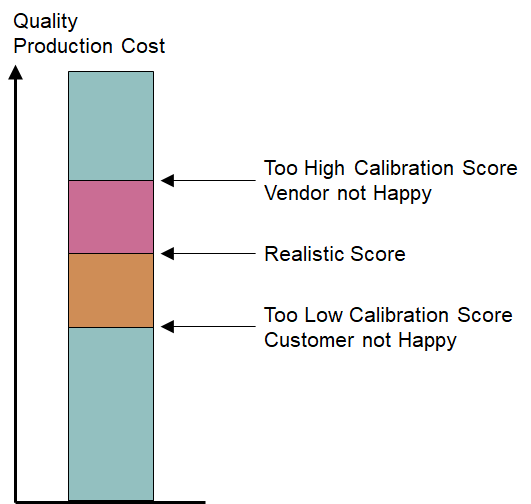
If the customer wants to negotiate for a very high service level without showing facts about how his has been achieved in the past, the vendor compensates for the increased risk by setting a higher price tag. The customer most probably gets what it wants, but at a premium price.
Baseline creation is a less risky approach, but not free from pitfalls.
The principle is easy. The vendor and the customer agree on a transitions period to deliver as planned, but the SLA is not binding but guiding. After the period, there [hopefully] is data enough to assess the resources needed for the delivery, and the realistic distribution of the incident ticket resolution times by application class. The binding SLA targets are set forth based on this data.
There are several pitfalls to avoid:
- Be too impatient and define too a short transition period, say two-three months. The results are likely to be random, especially if there are major seasonal variations in the customer's business.
- Taking the one-size-fits-all tactic. Services are different, and Service A may raise more tickets in week than Service B in a year. Averages do not necessarily describe any service. For some services, the target might be highly unrealistic.
- Draw conclusions based on insufficient data. Do not even think about setting application-specific time-to-resolve target based on a few tickets only.
- Including new unstable services. It takes time for a new service to reach a decent level of stability. Trying to create a baseline for unmature services will lead to failure.
- During the transition period, the service provider might avoid delivering higher service level than the minimum, as such may lead to stricter target setting than the vendor wants.
When setting target, it is essential think about the granularity. The common mistake is to measure every single application. For services raising a minimal number of tickets, the statistical analysis on a monthly basis usually leads to pure nonsense. If Application X raises two tickets a month, and one of then misses the time-to-resolve target once within 12 months, the SLA score for that metric is 50 % for that month, and the SLA shows red. Most probably, such a case is of less importance, and not worth discussing at all.
Do not forget simple math. If you want to set a time-to-resolve target to 95 % during a month, there must be 20 or more monthly tickets for this service to make the target reasonable. If there are say four tickets, the only possible scores are 0, 25, 50, 75, and 100 per cent. There is nothing between 75 and 100. Setting the target to 95 effectively is the same as the target of 100. Might turn expensive in terms of higher service fees.