Read more: |

Matti Grönroos
What is a Process?
The quality scientists can fight forever arguing where the boundary line is between a process and a procedure.
The older versions of the ITIL framework called many things processes while they really are not processes. Confused?
Everything is not subject to be declared a process. An example of this is the specialist work. Basically, a specialist is a person who knows what to do next, without a guidance by a framework. But what is included in the process?
The term "process" has several competing definitions. This one is pretty straightforward: Clearly defines series of actions that always repeats itself in the same way. Usually, a process in seen as something that delivers output and outcomes from well-defined inputs.
The latest version of the ITIL framework has replaced the word "process" by the word "practice". The processes have not disappeared, but the practices contain things which are processes in fact.
The IT processes often have a starting and ending point. This is, however, not carved in the rock. For example, the ITIL-defined Continual Service Improvement is pretty clearly a continuous process at least its outermost layers.
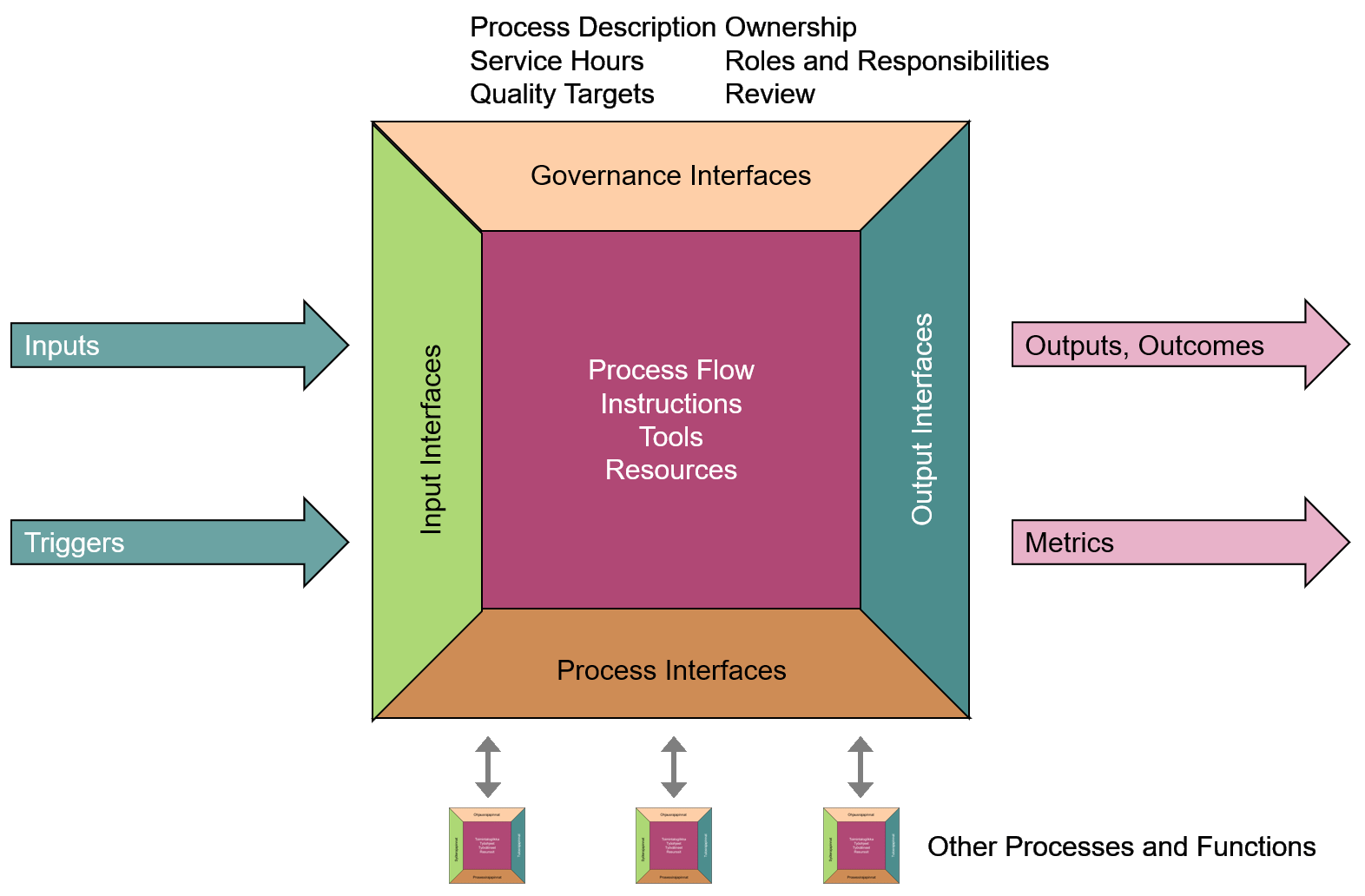
A process can be thought as a black box with several well-defined interfaces:
Too often, processes are designed by filling the walls by most complex process charts, and forgetting everything related to interfaces and success criteria. This seldom leads to success.
In our chart, the actual value is created horizontally, from left to right. The process has its triggers (incident report, change request, approaching review meeting, etc), and inputs. The process is a black box, and its internal workflow is a private matter. Finally, the process creates outputs, as well as data to assess its success.
At the top, there are interfaces and metadata related to the governance: process description, service hours, success criteria, quality metrics, how to access the process, etc. Ownership is the key thing: A process without ownership and out of control and monitoring, will not survive.
No process is an isolated island in the world. That is why inter-process communication is essential, shown at the bottom of the cart. For each pair of processes, there shall be a document to describe what the processes give to each other.